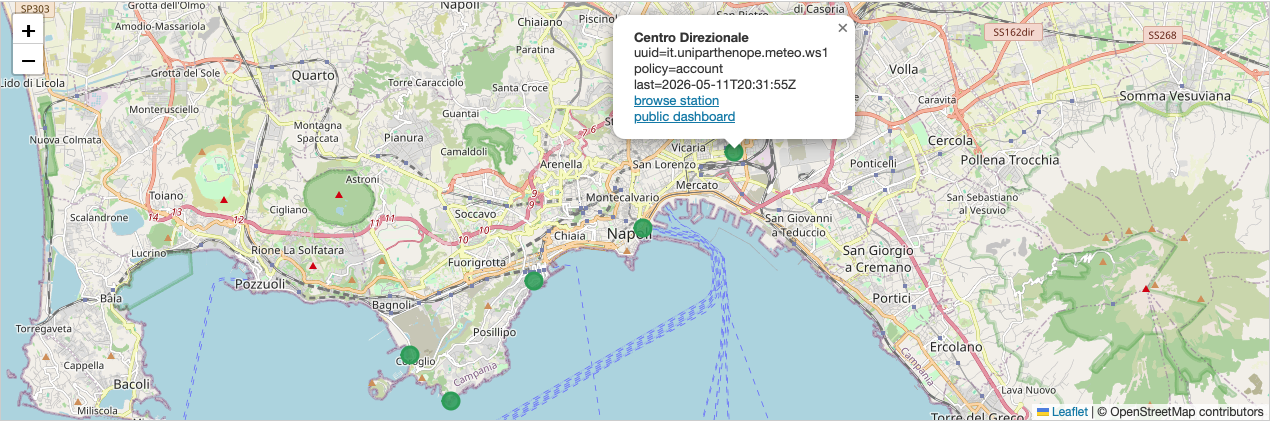
The meteo@uniparthenope ecosystem continues to evolve with the introduction of the new environmental sensor network platform available at https://network.meteo.uniparthenope.it, an infrastructure designed to federate weather stations, marine sensors, air quality systems, and environmental monitoring devices into a single open and scalable network.
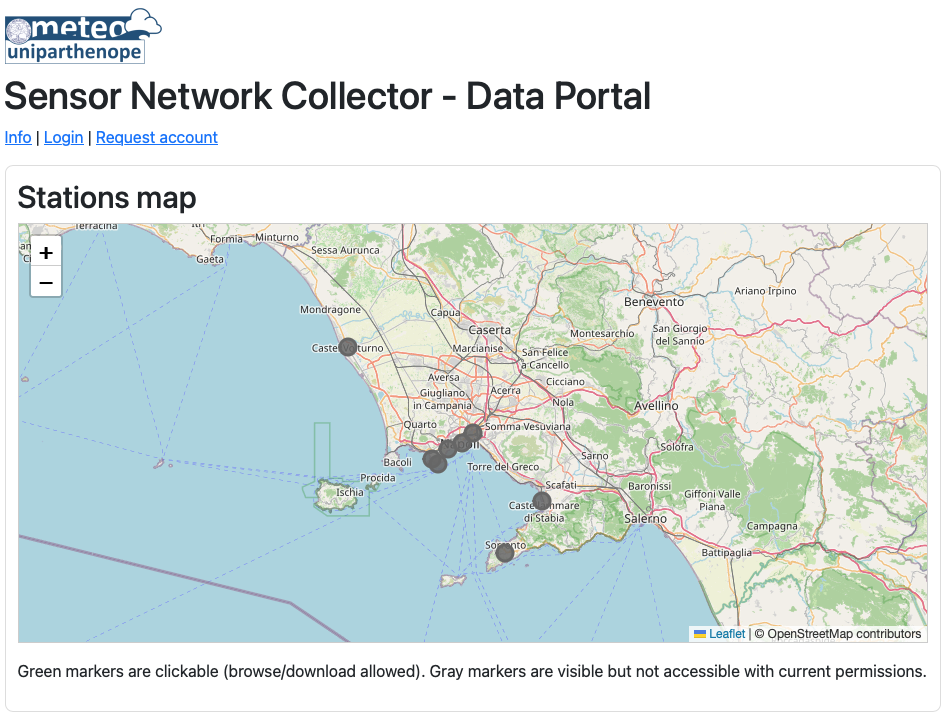
Developed within the activities of the Center for Monitoring and Modeling Marine and Atmosphere Applications (CMMMA) and the HPSC Lab of the University of Naples “Parthenope”, the new platform represents a shift from the traditional concept of a closed observational network toward a distributed and collaborative environmental sensing ecosystem.
The project has been designed around openness. Unlike conventional monitoring infrastructures that often restrict participation to predefined hardware vendors or proprietary technologies, the meteo@uniparthenope network is built to accept both institutional and privately operated stations through open protocols and interoperable software components. Citizens, schools, research centers, municipalities, sailing clubs, environmental associations, and public administrations can contribute their own sensors and observational systems to the network while maintaining control over their data and operational autonomy.
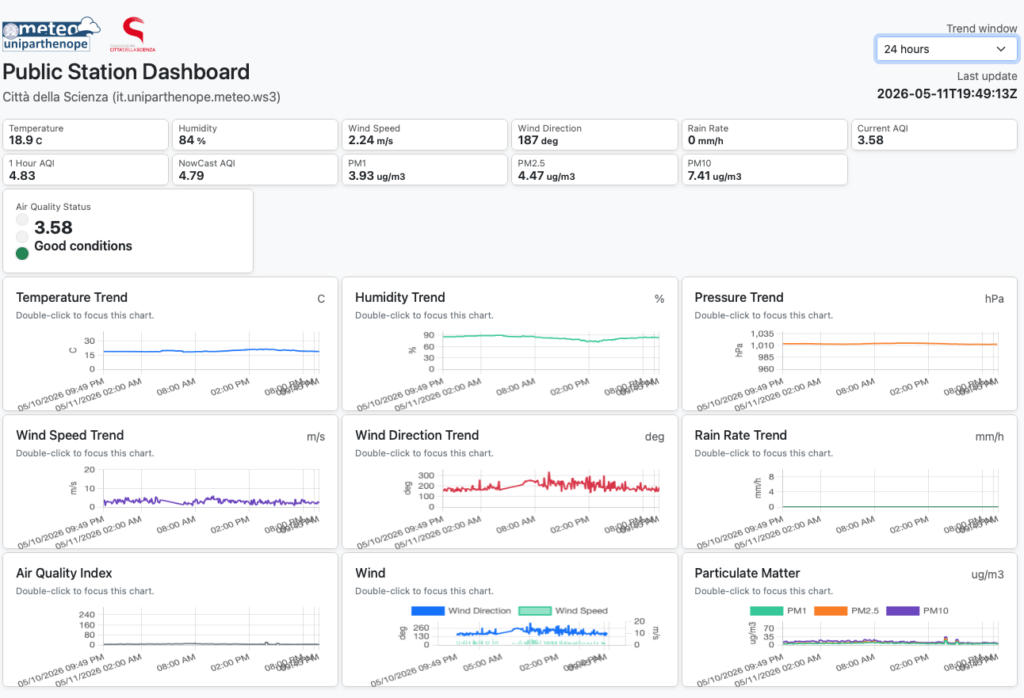
This approach enables the creation of a distributed observational infrastructure capable of growing organically across territories and environmental domains. A personal weather station installed on a rooftop, a marine sensor deployed onboard a sailing vessel, a river monitoring device, or an institutional environmental observatory can all become active nodes within the same ecosystem.
A central aspect of the platform is its strong adoption of open-source technologies. The network infrastructure has been developed using open standards and open software components specifically to avoid vendor lock-in and to encourage transparency, interoperability, reproducibility, and long-term sustainability. This technological openness simplifies the integration of heterogeneous sensors and allows developers and institutions to adapt the system to their own operational requirements.
The platform architecture has also been designed with data sovereignty as a core principle. Sensor owners maintain full ownership and governance of their observational data while deciding how and when to share measurements with the broader network. This model is particularly important for institutional deployments and research infrastructures where regulatory compliance, operational independence, and data governance policies play a fundamental role.
Rather than centralizing control, the system federates data access and interoperability, allowing observational resources to remain distributed while still contributing to larger environmental monitoring workflows. In this way, the network supports both local autonomy and collective environmental intelligence.
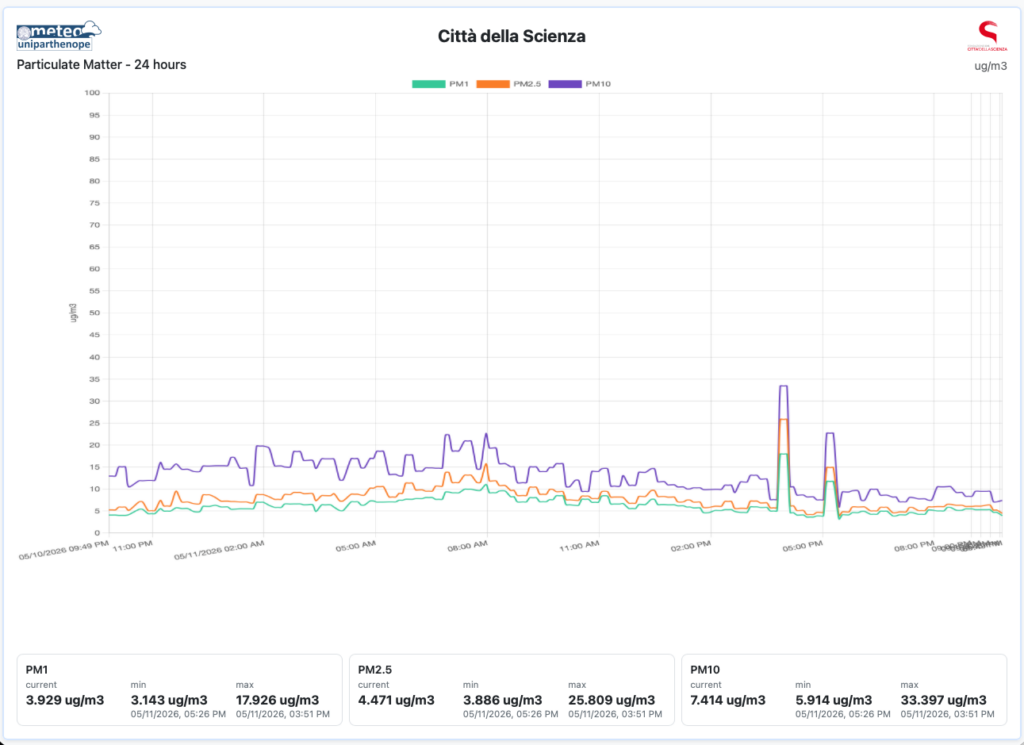
Scalability has been another guiding principle in the design of the infrastructure. Environmental sensor networks increasingly produce large volumes of real-time observations coming from highly heterogeneous sources, ranging from low-frequency meteorological stations to high-frequency marine and atmospheric sensors. The meteo@uniparthenope network has therefore been engineered to scale horizontally across distributed computational infrastructures, supporting real-time ingestion, storage, processing, and dissemination of environmental observations without compromising performance.
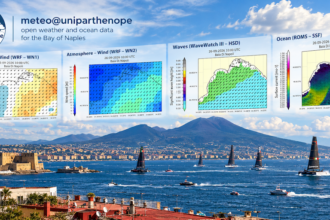
The platform integrates naturally with the broader meteo@uniparthenope operational ecosystem, including forecasting systems, marine services, open APIs, and environmental digital twins. Observational data collected through the network can contribute to validation activities, operational monitoring, nowcasting applications, scientific workflows, and citizen science initiatives.
Beyond its technological aspects, the initiative reflects a broader vision of environmental monitoring as a collaborative public infrastructure. Climate and environmental challenges increasingly require dense observational coverage, local participation, and interoperability between institutions and communities. By opening the network to both public and private contributors, meteo@uniparthenope promotes a participatory model where environmental observations become a shared resource supporting research, risk reduction, education, navigation, and territorial resilience.